Help Your Kids Gain the Surprising Benefits of Fewer Toys
Do you have children or grandchildren? Are you already thinking about which toys you want to buy them for Christmas? Are they already thinking about what they want to ask for?

Here's an interesting experiment. What happens when they only have one toy to play with? Even more intriguing – what happens when the only things they have to play with aren't toys?
German kindergartens removed all toys, and guess what happened? At first, the children were adrift, confused, and bored. They quarreled with each other. By the second day, they were cooperating to make up their own games, imagining that a row of chairs was a train, a box was a boat, and a blanket over a table made a cave.
When I was a kid, my brother and I would play for hours under the round picnic table on our patio, pretending we were in a space ship flying to the moon. My sister and I would seat our dolls on our bed and pretend we were driving our camper van on a marvelous vacation. An empty toilet paper tube could become a spyglass; a piece of fabric could become a cape, an apron, a doll blanket, and more; a wooden spoon was a sword, a microphone, or a magic wand. I remember my nephew, on one memorable occasion, pretending a wooden spoon was a scalpel as he "took out the 'pendix" on one of his stuffed animals (his dad had recently had the operation).

Why limits are better for all of us
When children are surrounded by toys, according to a many-times-duplicated study, they seem distracted as a they flit from item to item. With fewer toys, they engage with each one longer, and discover more ways to play with it. That they remain happily entertained for longer is great, but the real payoff is the level of creativity involved. Scarcity sparks innovation, transformation (turning a box into a racecar or a stick into a horse), and cooperation.
In our rush to give our children the most and the best, we may actually be crowding out the opportunity for real discovery, self-reliance, and social skills. Instead of showing your love by loading them up, maybe you need to slow down and make more careful choices.
After all, even adults thrive on limits. Instead of battling decision fatigue, we do better with a bit more routine and fewer choices. Instead of struggling to multi-task, we do better when we focus and take more time. Instead of straining to keep up with every new trend and gadget, we're more contented with a few high-quality favorites.
According to statista.com, North America is and has been the largest toy market in the world. A University of California analysis reveals that the U.S., with just 3.1% of the world's children, purchases 40% of the world's toys.
In other words, we're not just a little over-burdened with toys. We've easily moved into the super-excessive range.
All of that toy clutter isn't harmless, and I'm not just talking about the stray Legos and Barbie shoes that may be stabbing your feet as you navigate your home. A cluttered space is chaos to a developing mind. It erodes the ability to focus. A cluttered space ramps up the production of stress hormones like cortisol, which causes anxiety and frustration.
What emerges in a cleared space is profound: more interactions, more storytelling, and more resourcefulness.
How to get to less
Maybe you're convinced, but I'll be honest – this isn't easy. The world pulls us and our kids toward excess. Birthdays become unboxing marathons, and we already know that Christmas is a toy frenzy.
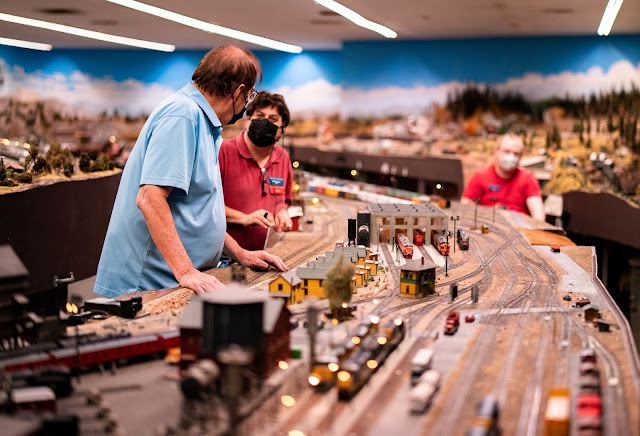
But what if we started touting experiences as the best gifts? My husband and I take our grandchildren to the train museum, the auto museum, the airplane museum, the zoo, and the planetarium. We recently took the older two to an appropriate theater production (Frozen at Broadway Sacramento). We play games together. We have read-aloud marathons. Some families might buy tools for a shared garden project, or bikes or hiking equipment for shared outings.
Many families use the concept of toy rotation, storing half (or more) of the toys out of sight and periodically cycling them back in. Children greet their old toys like new, and get far more value from them than if they had all been crammed into the playroom all the time.
And what if you'd like to declutter some toys now, before holiday toys enter the picture? Gather your kids and present sorting and discarding not as a chore, but as a treasure hunt. Which are their favorites? What do they love?
Donate the rest, reminding them that they will be enjoyed and cherished by another child. When your kids are part of this choice, you help them
- recognize that they have enough (more than enough)
- learn to identify what matters to them
- practice generosity to others
- experience more gratitude for what they have
As you pare back, your children learn to trust their own instincts and make the most of less. They connect with others, not through a possession they either share or fight over, but through stories they create and embody together. They worry less about pushing the right button or playing "the right way" (as with a video game or electronic toy) as they explore trial and error, learning and innovating as they go.
Wouldn't it be wonderful if our children learned that true abundance isn't in accumulation, but in attention, creation, and collaboration? Wouldn't it be great if they didn't just fill in a blank or pass a test, but dug for meanings and possibilities?
Fewer toys won't diminish their world, but expand it.



Comments
Post a Comment